Damage-free excavation
A damaged cable costs you more than the repair. It costs downtime, penalties and the client's confidence. Damage-free excavation with a suction excavator takes that risk out of the job.
- No steel in the ground, so no damage
- Safe around gas, water, power and fibre
- Non-conductive and non-sparking tooling
- You see what you expose before you carry on
Why traditional digging goes wrong
The ground rarely matches the utility drawings. Services sit deeper, shallower, or a few metres off the marked route, and sometimes there is something down there that appears on no drawing at all. With a bucket or a spade you find that out when it is already too late.
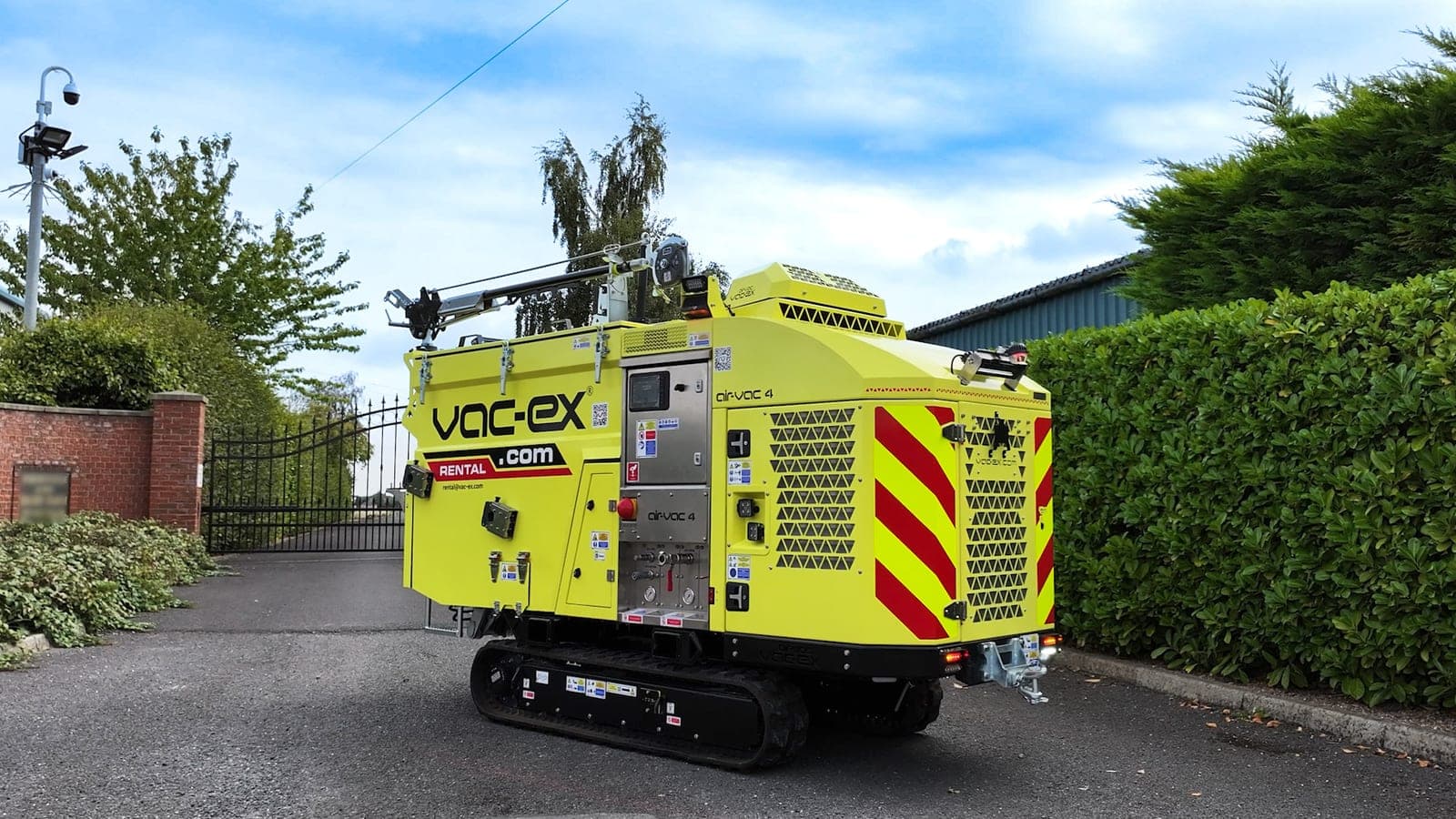
With suction excavation that moment does not arise. Nothing hard goes into the ground. Compressed air breaks up the soil, the turbine lifts it out, and whatever lies beneath comes into view undamaged. You are not working blind: you see, step by step, what is actually there.
What you avoid
Power outages
A severed medium-voltage cable takes out a whole neighbourhood and puts the network operator on your site immediately.
Gas escapes
A damaged gas connection means evacuation, an emergency callout and an incident investigation.
Fibre damage
Fibre is fragile and expensive to repair, and an outage usually affects hundreds of connections.
Downtime
Every strike stops the site until the network operator has repaired it. You never get those days back.
How we work damage-free
Look first
Check the utility drawings and the site, then decide where careful work is required.
Break up with air
The lance breaks up the ground with compressed air, putting no force on cables, pipes or roots.
Extract under control
The loosened soil goes straight into the tank, so the hole stays clean and you can see what you are exposing.
Where damage-free excavation makes the difference
Around existing services
Trial holes, service connections and crossings with other utilities. See exposing cables and pipes.
In the root zone
Roots stay whole and the tree stays standing. See tree root excavation.
In city centres
Little space, plenty of public and a densely occupied underground. Exactly where an excavator is the wrong tool.
In high-risk environments
Petrochemical sites, rail and airports, where a strike is not merely expensive but dangerous.
In short
Damage-free excavation is not a luxury. It is the cheapest option as soon as there is something in the ground.
- No repair bills for third-party services
- No shutdown imposed by the network operator
- No argument about liability
- A client who calls you back
Do it yourself or have it done
You can hire the machine and run it yourself. After a short hand-over most groundworkers manage well, because the technique is simpler than it looks. How that works is on vacuum excavation hire.
If the job is particularly delicate or you have nobody free, the operated set comes with one of our operators. He does the digging, you keep control of the site.
Frequently asked questions
What exactly does damage-free excavation mean?
Digging without damaging the services already in the ground. In practice that means not working with steel, but breaking up the soil with compressed air and extracting it, so cables, pipes and roots stay intact.
Is it genuinely safe around live cables?
Yes. The tooling is non-conductive, the lance nozzles are brass and non-sparking, and the lance is tested to 75 kV per foot. That is what allows work around power and in gas-enriched environments.
Does it work in heavy clay?
Yes, but it takes longer than in sand. For heavy ground we recommend a twin turbine machine such as the AIR-VAC 4 or the T-VAC 2. Describe your ground conditions and we will recommend the right type.
Does it replace the utility search?
No. The utility search remains mandatory and is your starting point. Damage-free excavation is the method you use afterwards to work safely, precisely because those drawings are never accurate to the centimetre.
How does the cost compare with hand digging?
A suction excavator costs more per day than two people with spades, but it is considerably faster and removes the risk of a strike. For trial holes and work around services it usually works out cheaper overall.
Do you work in Belgium as well?
Yes. Our working area is the Netherlands and Belgium. We deliver to both countries from Rhoon.
Read more
Vacuum excavation services
What vacuum excavation is, how it works and when to use it.
ViewVacuum excavation hire
Hire a VAC-EX suction excavator by the week, with or without an operator.
ViewSuction excavator hire
The VAC-EX machine range, from compact tracked unit to trailer.
ViewTree root excavation
Expose roots without damaging the root ball.
ViewRequest a booking
Choose your package and dates. We confirm availability within one working day.
Contact details
Tornado Rent B.V.
Dienstenstraat 1-5
3161 GN Rhoon
Marcel Haring
We deliver throughout the Netherlands and Belgium. Arrange transport yourself or let Tornado Rent handle it.